Training Principles
This section details the fundamental mechanisms that govern all animal behaviour. It is these fundamental principles that form the basis of all my training and behaviour modification techniques.
The Basics of Behaviour Modification
When you attempt to modify an animal’s behaviour, whether you’re reducing unwanted behaviours or teaching your pet new skills, you are dealing with both Classical and Operant Conditioning.
There is much debate on the scientific definition of the different conditioning processes, but these basic principles can be applied and adapted to suit any situation and species.
An Introduction into Classical Conditioning
Ivan Pavlov provided the first example of classical conditioning, while conducting research into the digestion of dogs in the late 1900's. Pavlov noticed that not only did the dogs salivate in the presence of food, but also when they saw the white coats of the lab technicians who fed them.
He predicted that if a particular stimulus within the dog's environment was present when they were fed, then that stimulus would become associated with this food reward and cause salivation on its own. He conducted a series of experiments to try and explain this phenomenon, his most famous being an experiment where the dogs were conditioned to salivate at the sound of a bell.
What is Classical Conditioning?
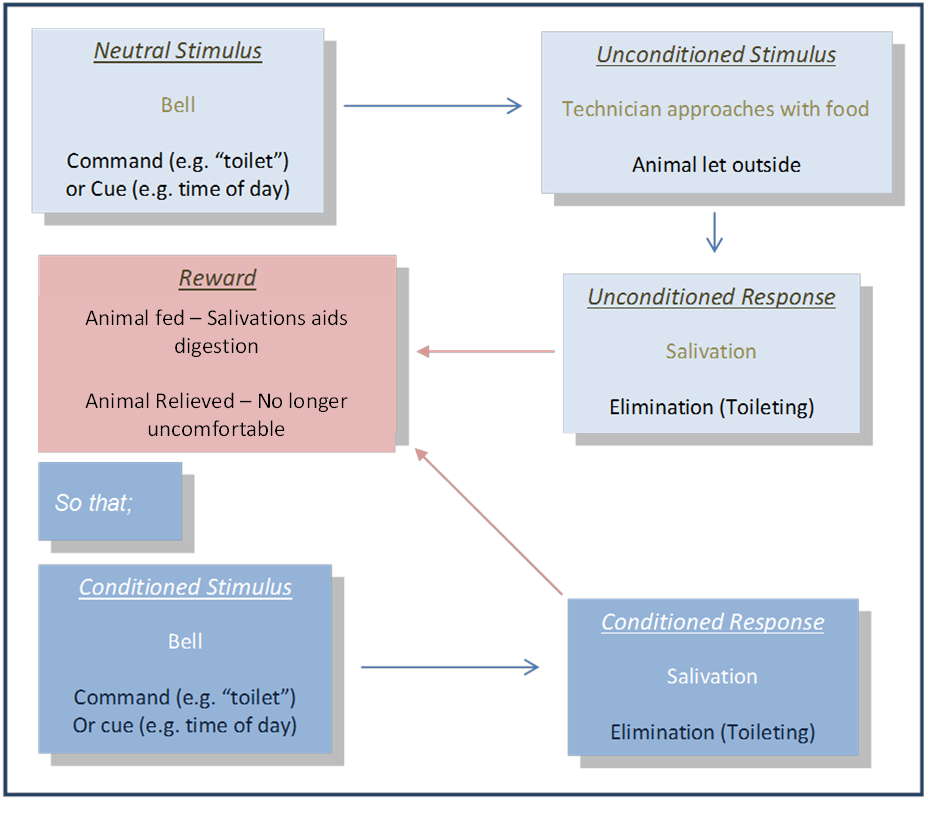
Classical conditioning is the process of learning to associate an Unconditioned Response with a Neutral Stimulus through the association of an Unconditioned Stimulus, in order for a Conditioned Stimulus to provide a Conditioned Response.
In other words, it is the process by which an animal learns to associate a natural behaviour or response with a reward, through means of a given cue or command.
Terminology:
Unconditioned Response
Neutral Stimulus
Unconditioned Stimulus
Conditioned Stimulus
Conditioned Response
An innate behaviour or physiological response.
A change in environment that would usually produce no response.
A change in environment that naturally produces a response.
A change in environment that once produced no response that now
produces a response.
A learnt response to a conditioned stimulus.
The Classical Conditioning Process
Copyright © 2011-13 Hayley de Ronde. All Rights Reserved - Privacy Policy - Terms & Conditions - Contact - Home